Quantum breakthrough without magnets: how light 'programs' atoms
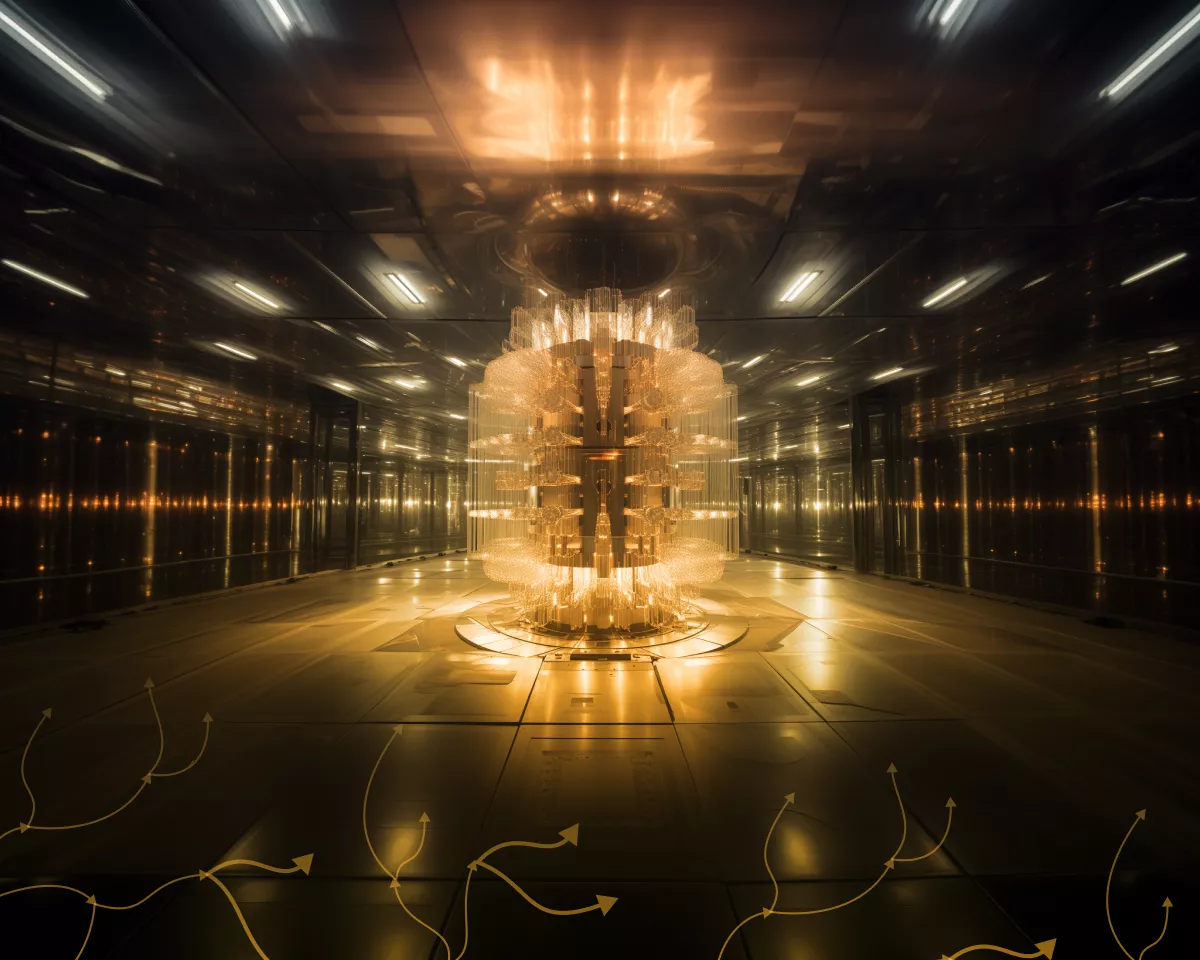
Physicists from the Faculty of Physics at Vilnius University have presented a theoretical model that could radically change the approach to controlling quantum systems. The development is based on using light to "program" atoms — all without bulky and energy-intensive external magnetic fields.
How Optical Programming Works
The idea is simple and elegant: a laser beam first sets atoms to a specific state, and then this pre-prepared medium itself begins to influence the shape and polarization of the complex light passing through it. The key element is optical vortices. These are beams with a spiral wavefront, where the intensity drops to zero at the center, forming a dark "core." The size of this core is determined by the topological charge — a value that can take any integer, both positive and negative.
In practice, this opens access to tens of thousands of different states. Instead of the familiar qubits, which operate with only two states, qudits — multidimensional quantum units of information — can be used here. This means an exponential increase in computing power without increasing the physical volume of the system.
Three-Level Architecture and Feedback
To control vector vortices, the researchers modeled the interaction of a laser beam with an atomic gas, where each atom has three energy levels. In such a system, the prepared medium literally "inherits" the spatial pattern of light: in some areas, atoms actively absorb radiation, while in others they become almost transparent. A feedback effect occurs — the atomic response reshapes the beam itself. Instead of a simple ring structure, a complex petal-like pattern with several bright zones around the center is formed, and the polarization structure also changes.
Previously, such control required powerful external magnetic fields and complex laboratory equipment. Now, at least in theory, all of this can be replaced by a single laser beam.
Prospects and My View
This development is not just an academic exercise. It theoretically paves the way for faster quantum processors, highly secure quantum communication networks, and ultra-precise optical sensors. If the model is successfully implemented in practice, we will get compact and energy-efficient quantum devices that do not require cryogenic magnets.
My analytical assessment: at this point, it is pure theory, but its potential is enormous. Simplifying the hardware base is a key barrier to commercially available quantum computers. If this approach can be experimentally verified, it could become as groundbreaking as the advent of the first semiconductor transistors. Keep an eye on news from Vilnius — we may be witnessing the birth of a new standard in quantum engineering.