Quantum breakthrough without magnets: a new model of "programming" atoms with light
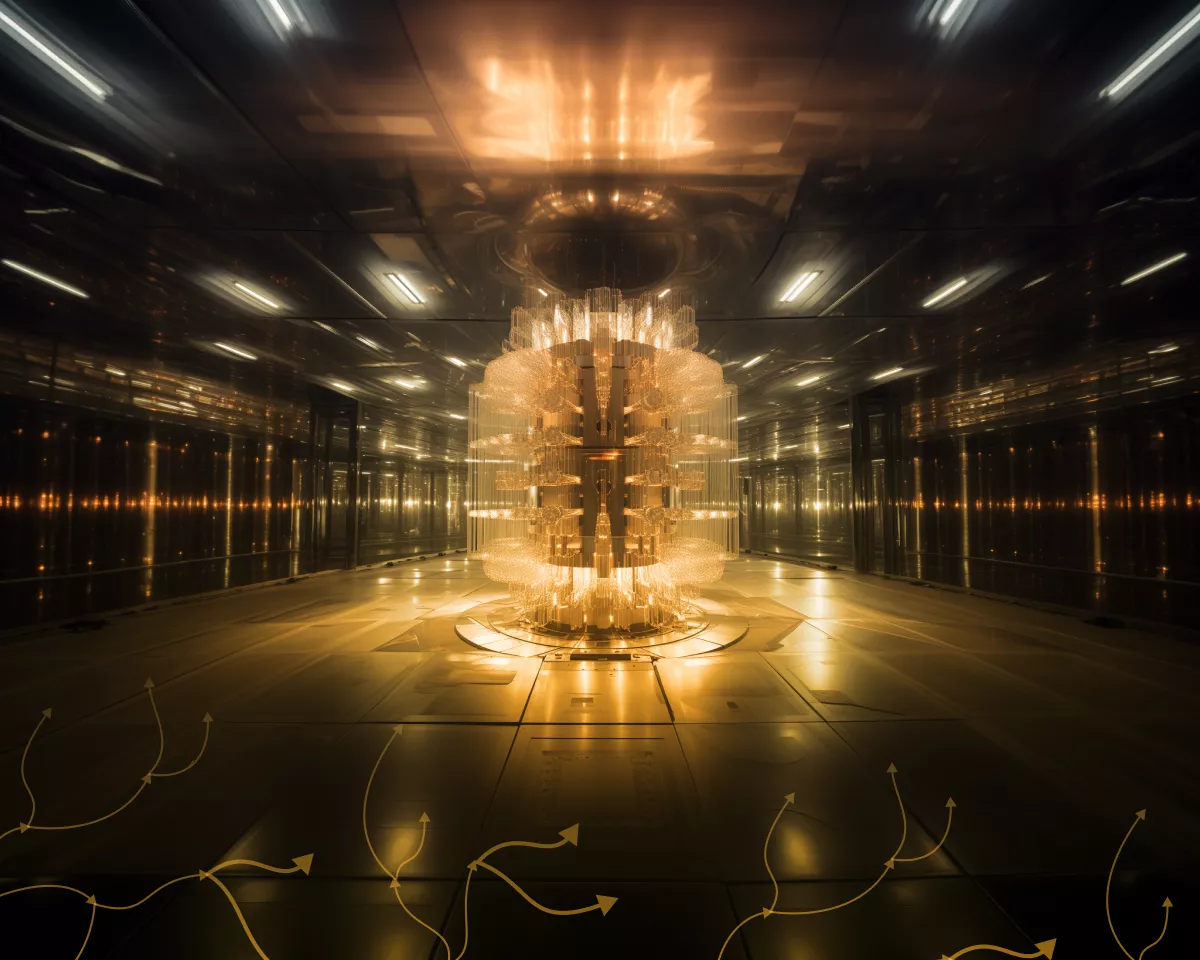
The world of quantum technology is on the verge of a significant simplification. A group of physicists from Vilnius University has presented a theoretical model that allows "programming" atoms using light, completely eliminating external magnetic fields. This is not just a laboratory curiosity, but a potential paradigm shift in the control of quantum systems.
The model is based on optical vortices—laser beams with a spiral wavefront, where the intensity drops to zero at the center. The size of this dark region, known as the topological charge, can take any integer value—both positive and negative. In practice, this opens access to 10,000 different states, allowing information to be encoded in qudits—multidimensional units of quantum information that significantly surpass traditional qubits in capacity.
How It Works: Light Controls Matter
The process resembles an elegant dance: light first "programs" the atomic medium, and then this medium alters the shape and polarization of the laser beams. The researchers simulated the interaction of a vector vortex with an atomic gas, where the atoms have three energy levels. As a result, the prepared medium inherits the spatial pattern of light: in some areas, atoms enhance absorption, while in others they become nearly transparent. A feedback loop emerges—the atomic response reshapes the beam itself, transforming a simple ring structure into a complex petal pattern with altered polarization.
Previously, such control required powerful magnets and bulky equipment. The new model promises to eliminate these limitations, paving the way for more compact and faster quantum processors.
Practical Prospects
Theoretically, this development could accelerate the emergence of highly secure quantum communication networks and ultra-precise optical sensors. While the industry focuses on increasing the number of qubits—for example, Sandia National Laboratories and Quantinuum recently unveiled the 98-qubit Helios system—the approach with qudits and optical programming offers an alternative path: not just increasing quantity, but changing the quality of computation.
Expert Opinion: Eliminating magnetic fields is not just a technical simplification. It removes one of the main sources of noise and instability in quantum systems. If the model is experimentally confirmed, we could see a fundamentally new class of quantum devices where control is achieved not through the brute force of fields, but through the fine-tuning of light.